
Take the Superfood-Group Challenge!
By Dr. Madeline
The Challenge: Include a superfood group in your diet each week to improve overall health.
Part 1: For Everybody
The topic of Superfoods is always a classroom favorite. There is an innate and palpable excitement with the idea that one food can cure all. But at the end of the lesson, I tell them a secret: just about any whole food grown cleanly and naturally from the earth can be called a “superfood.” It’s true that certain particular whole foods can be very beneficial for specific ailments; however, there is no one superfood that prevails for human health above all others.
As we embrace our individuality and different dietary needs, it is imperative that we recognize that while a certain whole food might be a “superfood” for one person, for someone else it may cause an allergic reaction or be unavailable.
So, instead, I offer you The Superfood Groups. These diverse groups consist of a subset of natural foods that, when eaten in variety, provide optimum health benefits, allow for choices across broad dietary needs, and make you feel good because you are taking care of your beautiful body.
In this four-part series (of which this is Part 1), we will first explore basic superfood groups and then dive into more specific superfood groups for vegans, vegetarians, and omnivores.
The research is clear that the Superfood Groups in this series, when incorporated into your regular diet, can improve health, boost the immune system, and may decrease negative aspects of most chronic diseases. If you are new to eating whole foods, start small. Consider a switch-out of a processed food you eat regularly for a food from a Superfood Group. As time goes on, you can add more. Use the Shopping Cart Checklist to assess your cart and help you add Superfood Groups each time you shop.
Superfood Groups-The Basics
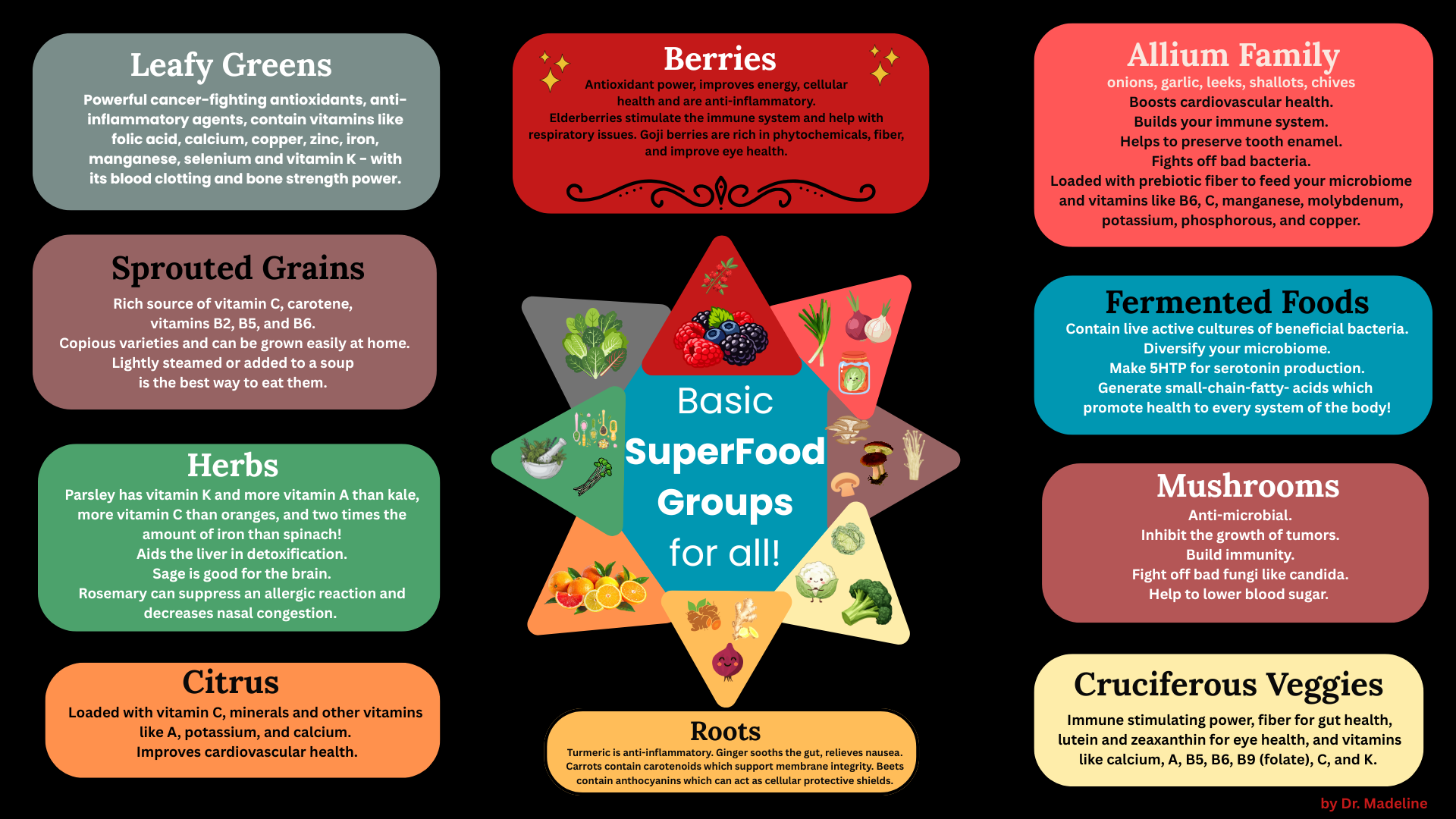
Leafy Greens: Spinach, Kale, Arugula, Swiss chard, Cabbage, Collard greens, and Watercress.
Mix and match these wonderful leaves into your diet, and you’ll increase your intake of powerful cancer-fighting antioxidants, anti-inflammatory agents, vitamins like folic acid, calcium, copper, zinc, iron, manganese, selenium, and even vitamin K - with its blood-clotting and bone-strength power.
Sprouted grains: Mung beans, Peas, Bulgur, Radish; the list goes on as almost any grain can be sprouted.
Once grains are sprouted, they are a rich source of vitamin C, carotene, vitamins B2, B5, and B6. In addition to the nutrients, the sprouting process neutralizes phytic acid (found in the bran of all grains), which inhibits digestive enzymes and can block absorption of essential nutrients. Lightly steamed or added to a soup is the best way to eat the sprouted grains. Not recommended due to inflammatory and immunosuppressive properties, are alfalfa sprouts, due to canavanine found only in the sprouted form of this plant. Certain (non-irradiated) seeds (Chia, Sunflower) and nuts (Peanuts, skinless Almonds) can also be easily sprouted at home.
Cruciferous Vegetables: Broccoli, Cauliflower, Cabbage, Brussels sprouts, Chard, Daikon, Horseradish and Turnip.
With their immune-stimulating power, cruciferous vegetables not only help you keep bacteria and viruses under control, but they also help fight against cancer using powerful phytochemicals. With fiber for gut health, lutein and zeaxanthin for eye health, and vitamins like calcium, A, B5, B6, B9 (folate), C, and K, these cruciferous creations pack a powerful punch to what ails you and can build your bones to boot!
Citrus: Lemons, Limes, Oranges, Grapefruits, Kumquats
Best known for their vitamin C content, which is a powerful antioxidant (if you’re wondering what an antioxidant is, please see my article here and flip to page 12), a sweet citrus eating experience also gives your body essential minerals and other vitamins like A, potassium, and calcium. Citrus fruits have also been shown to improve cardiovascular health, so your heart and blood vessels will thank you for squeezing some lemon into your water, enjoying an orange, or popping a sweet kumquat into your mouth!
Herbs: Thyme, Sage, Rosemary, Oregano, Basil, Parsley
Did you know that parsley has vitamin K and more vitamin A than kale, more vitamin C than oranges, and two times the amount of iron as spinach? Parsley helps your liver in its important role of detoxifying the body. Sage is good for the brain, and rosemary can suppress an allergic reaction, decrease nasal congestion, and destroy mold. In short, grow an herb garden and add these wonderful plants to your daily meals for powerful cleansing and nutrient enrichment to your cells.
Roots: Turmeric, Ginger, Onions, Carrots, Beets
Roots grow underground and, when incorporated into the diet, can wield a positively mighty influence on your health. All provide essential vitamins and minerals and are loaded with antioxidants. Turmeric is well known for its anti-inflammatory properties due to its curcumin content, which, in many studies, has been shown to be as effective as anti-inflammatory drugs. Turmeric’s health benefits abound, with articles about fighting Alzheimer’s, decreasing the risk of heart disease and cancer, and even relieving arthritis. Ginger has long been a soother of the gut, can relieve nausea, and has antibiotic properties to help positively reset the gut microbiome.
Carrots contain a group of antioxidants called carotenoids, which have been shown to block DNA and cellular membrane damage caused by free radicals. In addition, carrots contain a substance known as lycopene and other phytochemicals that fight off cancer cells in your body. When you eat vegetables, fruits, and roots with the color hues from red to purple, you consume powerful antioxidants called anthocyanins. Anthocyanins vary in color in response to UV light and act as cellular shields. We reap the protective benefits when we consume these wonderfully colorful foods.
Allium Family: Garlic, Onion, Shallot, Leeks, Chives
The Allium family is a fantastic way to start cooking a recipe. With some olive oil on low heat, add one of the allium family members and then some leafy greens to get a vitamin and mineral boost. This wonderful family of plants has been shown to exhibit anti-cancer, anti-viral, anti-bacterial, anti-fungal, and anti-yeast properties. In addition, they are a form of prebiotic which feeds the microbiome. The microbiome is essential for building a robust immune system and generating short-chain fatty acids, which promote health in every system of the body.
So, from decreasing your chances of getting the common cold, boosting cardiovascular health, building your immune system, helping to preserve tooth enamel, fighting off bad bacteria, and increasing your intake of vitamin B6, C, manganese, molybdenum, potassium, phosphorus, and copper, you just can’t go wrong with these savory alliums!
Berries: Blueberries, Raspberries, Blackberries, Goji Berries, Elderberries, Mulberries, etc.
Berries display a variety of anthocyanin-rich rainbow hues packed with antioxidant power. These superfoods will improve cellular health, are anti-inflammatory, and, as one of my dear friends describes them, taste like “God’s candy!” Elderberries are known to stimulate the immune system and help with respiratory issues. The Gogi berry, also known as wolfberry, is a common ingredient in traditional Chinese medicine, dating back thousands of years, with various health benefits including eye health, sleep success, and overall improved energy. The goji berry is rich in phytochemicals, fiber, calcium, zinc, selenium, and even amino acids (the building blocks of proteins). In addition, goji berries contain vitamins B and C, beta-carotene, and 33 minerals! While each type of berry holds an array of studied health benefits, I recommend mixing them up for optimal benefits.
Fermented Foods: Yogurt, Kefir, Kimchi, Fermented vegetables, Pickles, Sauerkraut, Olives, etc.
Fermented foods are those that contain live active cultures of beneficial bacteria. These bacteria live in your gut and are a major part of your immune system. In other words, they help keep you from getting sick! Although these microflora can regenerate in the gut (as long as you are eating whole foods with fiber), if you don’t regularly replenish with fermented foods, you can create an environment for unfavorable bacteria or fungi (like Candida) to take up residence instead. So, it’s important to keep a fresh supply of good bacteria coming in each day. Not a lot; a little bit of daily fermented food goes a long way. In addition, the more diverse the microbiome, the better the health for each body organ! Experiment with different fermented foods each week that make your body happy. Need a review on the microbiome? Check out my article in the Coop Scoop Blog here.
Mushrooms
Mushrooms are antimicrobial (that means antibacterial and antiviral), have been shown to inhibit the growth of tumors (they fight off cancer!), build immunity (they have been shown to fight off polio, hepatitis B, flu, and streptococcus!), fight off bad fungi like Candida, and even help lower blood sugar (helping those with diabetes). I know many individuals abhor the mushroom, mostly due to texture and their funny look. But this savory family of fungi is packed with a host of nutritional power, so even if you don’t like the texture, add some to your soup stock to reap some of the benefits that your body will thank you for!
The Superfood Groups listed here are to get you started on your journey toward health. The Superfood Group Shopping Checklist summarizes my Superfood Groups that will span the series.

Dr. Madeline has a Ph.D. in molecular, cellular, and developmental biology. She works at a local college where she teaches in the biology department. Check out her writing in The Coop Scoop or the HWFC Blog. Have a question or a suggestion for a future topic? MadHealthDoc@gmail.com She is not on social media so you can’t find her, follow her or subscribe to her channel. Instead, she hopes that you take a deep breath and let it out slowly. Then, smile and go outside.
View all the Coop Scoop Blog posts here.