
By Dr. Madeline
Part 4: For Omnivores
(Part 1: For Everybody is here, Part 2: For Vegans is here, and Part 3: For Vegetarians is here.)
Animal protein and fat sourced from sustainable farms that provide grass-fed and finished meat, without the use of hormones, antibiotics, or other synthetic chemicals, are among the richest sources of nutrition. Animal protein and fat provide the building blocks of human anatomy. When anatomy is built soundly, it supports the proper functions (physiology) of our diverse anatomical structures, from large bones to the tiniest molecule within our cells.
In Dr. Catherine Shannan’s book, Deep Nutrition, the research she outlines concludes with the four pillars of food groups found in every historical and traditional diet from across the globe (except the American diet!). These four pillars are: meat on the bone, sprouted grains, fermented foods, and organ meats. Survival in the wild world required humans throughout history to persevere across every continent and in all climates by creating staples based on these four pillars.
The Superfoods for omnivores listed below are meant to be additions to the superfoods that I’ve already discussed in Parts 1-3 of this Superfood series. If you are a strict carnivore, then you already know what your superfood is!
The research indicates that the Superfoods below, when incorporated into your regular diet, can improve overall health, boost the immune system, and may decrease negative aspects of most chronic diseases. If you are new to eating whole foods, start small. Consider a switch-out of a processed food you eat regularly for a food from a Superfood below. For instance, if you cook your eggs in a processed seed oil, consider using lard instead. If you eat chicken tenders, consider fresh chicken wings instead. (Then, you can use the leftover bones to make a bone broth.) As time goes on, you can incorporate more superfoods into your daily life.
Use the Superfood Group Shopping Cart Checklist at the bottom of this article to help you include superfoods in your diet each time you shop.
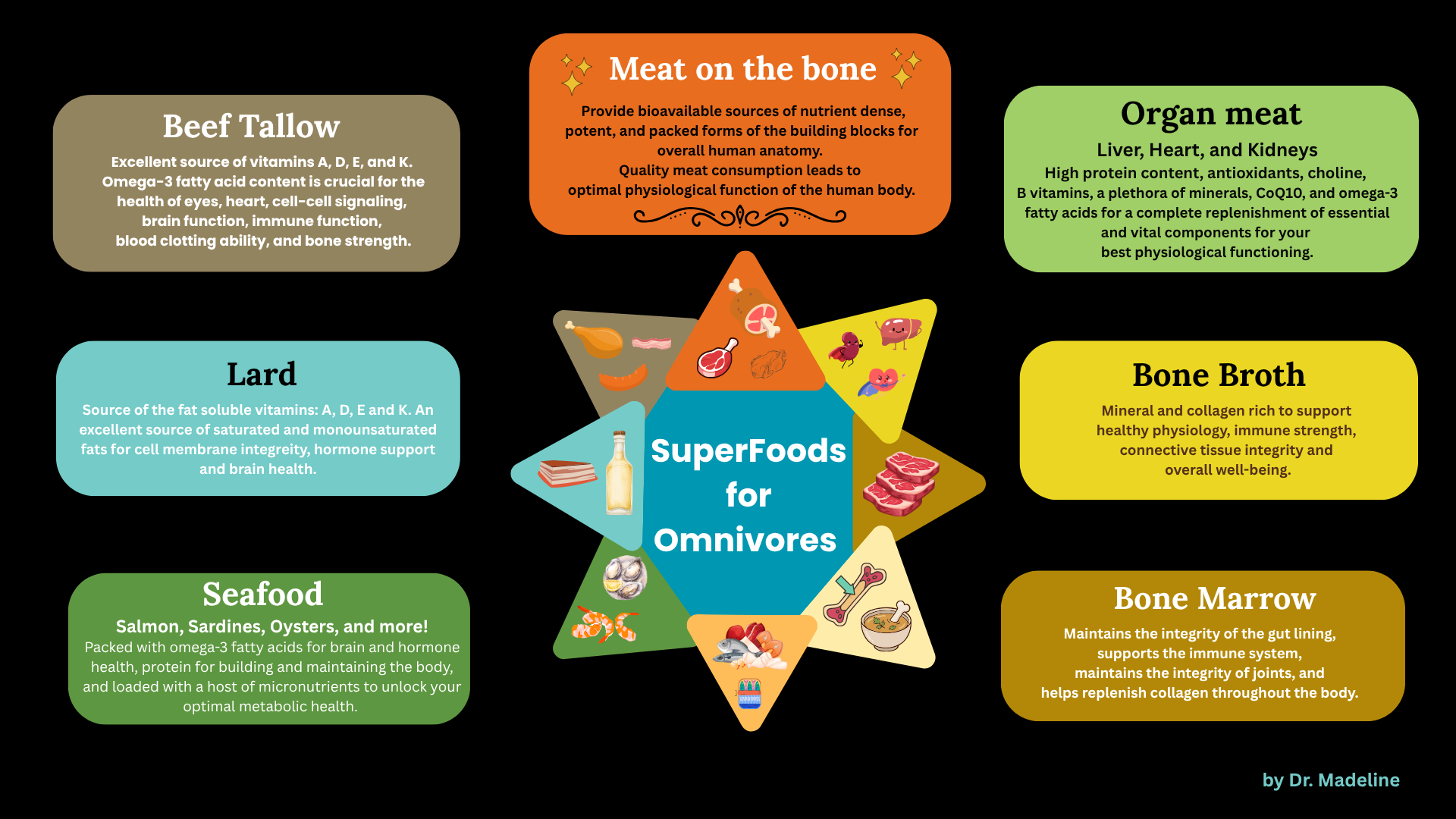
Superfoods for Omnivores
Review the foods outlined in Parts 1-3 of my Superfood series and add:
Meat on the bone: Beef, chicken, turkey, and pork provide bioavailable sources of nutrient-dense, potent, and packed forms of the building blocks for overall human anatomy and optimal physiological function. Especially if you have an injury, animal protein can help provide the necessary materials to rebuild anatomy with structural integrity.
Bone Broth: Mineral- and collagen-rich, these support healthy physiology, immune strength, connective tissue integrity, and overall well-being. If bone broth is hard for you to consume, consider a good collagen supplement and add it to your morning coffee, a smoothie, or to soups and stews. Collagen is the most abundant protein in the human body and helps build hair, skin, and nail integrity. It also helps keep your tendons and ligaments strong to maintain strong joints. Collagen is the protein most abundant in your blood vessels, supporting the walls of arteries, veins, and capillaries. This is why collagen, when consumed daily, can provide relief for those who suffer from Raynaud’s Syndrome, as it supports healthy blood flow by maintaining the integrity of blood vessels.
Organ meat: Probably the densest form of vitamins and minerals of any food. If I had to pick one food to label a superfood, I would choose liver. In addition to its protein content, it contains antioxidants, choline, B vitamins, a plethora of minerals, CoQ10, and omega-3 fatty acids. Most traditional diets include organ meat because our ancestors recognized the nutrient richness obtained from this group of foods. Fresh organic liver from quality sources is optimal. The liver is an organ that has over 500 vital functions, and one of them is detoxification. If you are consuming liver from an animal exposed to antibiotics, synthetic hormones, and overall poor food quality, the liver will be loaded with these toxins. This would NOT be the liver for you to eat. Be sure that if you eat liver, you’re eating fresh liver from organic pasture-raised cows, chickens, or wild game.
Seafood: Packed with omega-3 fatty acids for brain and hormone health, protein for building and maintaining the body, and loaded with a host of micronutrients to unlock your optimal metabolic health. Fresh, wild-caught seafood is optimal, as food from the sea contains rich sources of protein, fat, and essential minerals. Much farmed seafood contains toxins that can include hormones, antibiotics, and poor-quality food. But it depends on the farm. Just like we at the HWFC know our produce farmers, we also need to know our fish farmers. There are some truly excellent and local fish farms that stack up to, or come out even better than, wild-caught seafood. Ask our wonderful staff at the meat counter for details.
Lard: A source of the fat-soluble vitamins A, D, E, and K. An excellent source of saturated and monounsaturated fats. A great alternative to seed oils for frying, lard has a low smoke point, does not turn rancid at high heat, and helps keep you full longer.
Beef Tallow: Add to soups and stews for an excellent source of vitamins A, D, E, and K, and omega-3 fatty acids, which are crucial for the health of eyes, heart, cell-cell signaling, brain function, immune function, blood clotting ability, and bone strength. Incorporating sources of good fats into the diet can decrease hunger, reduce insulin spikes, and decrease inflammation in the body. Finally, beef tallow is an excellent skin moisturizer. As always, be sure to read and evaluate all of the ingredients on any product you purchase.
Bone Marrow: Inside bones is a unique substance called marrow. Specialized stem cells for the creation of red blood cells, white blood cells, and platelets reside here. The marrow is highly mineralized and contains the protein collagen in a gelatin form packed with minerals and nutrients. Consuming bone marrow can help maintain the integrity of the gut lining, support the immune system, maintain the integrity of joints, and help replenish collagen throughout the body. It is a highly nutritious food, and one can eat it directly or gain its health benefits from making a good bone stock.
In addition to all of these wonderful superfoods, don’t forget to stay hydrated. A glass of quality water with a pinch of sea salt (if it tastes salty, you added too much!) and/or a squeeze of citrus helps water get absorbed into the many compartments of your body.
The Superfood Groups listed here and throughout this series are to get you started on your journey toward health. The Superfood Group Shopping Checklist should help you stay on task when shopping, so when you get home you are assured you’re feeding yourself well!

Dr. Madeline has a Ph.D. in molecular, cellular, and developmental biology. She works at a local college where she teaches in the biology department. Check out her writing in The Coop Scoop or the HWFC Blog. Have a question or a suggestion for a future topic? MadHealthDoc@gmail.com She is not on social media so you can’t find her, follow her or subscribe to her channel. Instead, she hopes that you take a deep breath and let it out slowly. Then, smile and go outside.
View all the Coop Scoop Blog posts here.
References for all Four Superfood Articles
Animal Foods, Fats & Traditional Diets
Barendse, W. (2014). Should animal fats be back on the table? A critical review of the human health effects of animal fat. Animal Production Science, 54, 831–855.
Hewlings, S. (2020). Coconuts and health: Different chain lengths of saturated fats require different consideration. Journal of Cardiovascular Development and Disease, 7(4), 59.
Nourishing Traditions. Fallon, S. (2001). New Trends Publishing.
Zhang, R., Zhang, H., Wang, Y., et al. (2023). Higher consumption of animal organ meat is associated with a lower prevalence of nonalcoholic steatohepatitis. Hepatobiliary Surgery and Nutrition, 12(5), 645–657.
Fruits, Berries & Polyphenols
Amagase, H., Sun, B., & Borek, C. (2009). Lycium barbarum (goji) juice improves in vivo antioxidant biomarkers in serum of healthy adults. Nutrition Research, 29(1), 19–25.
Amagase, H., Sun, B., & Nance, D. M. (2009). Immunomodulatory effects of a standardized Lycium barbarum fruit juice in Chinese older healthy human subjects. Journal of Medicinal Food, 12(5), 1159–1165.
Fernandes, I., Faria, A., Azevedo, J., et al. (2010). Influence of anthocyanins and related phenolics on breast cancer cell proliferation. Journal of Agricultural and Food Chemistry, 58(6), 3785–3792.
Joseph, J. A., Shukitt-Hale, B., & Casadesus, G. (2005). Reversing the deleterious effects of aging on neuronal communication and behavior: Beneficial properties of fruit polyphenolic compounds. American Journal of Clinical Nutrition, 81(1 Suppl.), 313S–316S.
Nurk, E., Refsum, H., Drevon, C. A., et al. (2010). Cognitive performance among the elderly in relation to the intake of plant foods. British Journal of Nutrition, 104(8), 1190–1201.
Potterat, O. (2010). Goji (Lycium barbarum and L. chinense): Phytochemistry, pharmacology and safety. Planta Medica, 76(1), 7–19.
Torri, E., Lemos, M., Caliari, V., et al. (2007). Anti-inflammatory and antinociceptive properties of blueberry extract. Journal of Pharmacy and Pharmacology, 59(4), 591–596.
Cruciferous Vegetables (Broccoli, Kale, DIM, Sulforaphane)
Kim, H. J., Barajas, B., Wang, M., & Nel, A. E. (2008). Nrf2 activation by sulforaphane restores age-related decreases in immunity. Journal of Allergy and Clinical Immunology, 121(5), 1255–1261.
Kim, S. Y., Yoon, S., Kwon, S. M., et al. (2008). Kale juice improves coronary artery disease risk factors in hypercholesterolemic men. Biomedical and Environmental Sciences, 21(2), 91–97.
Le, H. T., Schaldach, C. M., Firestone, G. L., & Bjeldanes, L. F. (2003). Plant-derived 3,3′-diindolylmethane is a strong androgen antagonist in prostate cancer cells. Journal of Biological Chemistry, 278(23), 21136–21145.
Li, Y., Zhang, T., Korkaya, H., et al. (2010). Sulforaphane inhibits breast cancer stem cells. Clinical Cancer Research, 16(9), 2580–2590.
Murugan, S. S., Balakrishnamurthy, P., & Mathew, Y. J. (2007). Antimutagenic effect of broccoli flower head. Phytotherapy Research, 21(6), 545–547.
Riby, J. E., Xue, L., Chatterji, U., et al. (2006). Activation and potentiation of interferon-gamma signaling by 3,3′-diindolylmethane. Molecular Pharmacology, 69(2), 430–439.
Garlic & Onion
Duda, G., Suliburska, J., & Pupek-Musialik, D. (2008). Effects of short-term garlic supplementation on lipid metabolism and antioxidant status. Pharmacological Reports, 60(2), 163–170.
Gorinstein, S., Jastrzebski, Z., Namiesnik, J., et al. (2007). The atherosclerotic heart disease and protecting properties of garlic. Molecular Nutrition & Food Research, 51(11), 1365–1381.
Kook, S., Kim, G. H., & Choi, K. (2009). The antidiabetic effect of onion and garlic in experimental diabetic rats. Journal of Medicinal Food, 12(3), 552–560.
Mayer, B., Kalus, U., Grigorov, A., et al. (2001). Effects of an onion-olive oil maceration product on blood pressure and blood fluidity. Arzneimittelforschung, 51(2), 104–111.
Nantz, M. P., Rowe, C. A., Muller, C. E., et al. (2012). Supplementation with aged garlic extract improves immune function. Clinical Nutrition, 31(3), 337–344.
Wagner, H., Dorsch, W., Bayer, T., et al. (1990). Antiasthmatic effects of onions. Prostaglandins, Leukotrienes and Essential Fatty Acids, 39(1), 59–62.
Yeh, Y. Y., & Liu, L. (2001). Cholesterol-lowering effect of garlic extracts and organosulfur compounds. Journal of Nutrition, 131(3 Suppl.), 989S–993S.
Ginger
Ali, B. H., Blunden, G., Tanira, M. O., & Nemmar, A. (2008). Some phytochemical, pharmacological and toxicological properties of ginger. Food and Chemical Toxicology, 46(2), 409–420.
Alizadeh-Navaei, R., Roozbeh, F., Saravi, M., et al. (2008). Investigation of the effect of ginger on lipid levels. Saudi Medical Journal, 29(9), 1280–1284.
Borrelli, F., Capasso, R., Aviello, G., Pittler, M. H., & Izzo, A. A. (2005). Effectiveness and safety of ginger in the treatment of pregnancy-induced nausea and vomiting. Obstetrics & Gynecology, 105(4), 849–856.
Park, M., Bae, J., & Lee, D. S. (2008). Antibacterial activity of gingerol compounds isolated from ginger rhizome. Phytotherapy Research, 22(11), 1446–1449.
Priya Rani, M., Padmakumari, K. P., Sankarikutty, B., et al. (2010). Inhibitory potential of ginger extracts against enzymes linked to type 2 diabetes and inflammation. International Journal of Food Sciences and Nutrition.
Mushrooms & Medicinal Fungi
Akihisa, T., Franzblau, S. G., Tokuda, H., et al. (2005). Antitubercular activity of compounds from Hypsizigus marmoreus. Biological & Pharmaceutical Bulletin, 28(6), 1117–1119.
Lu, X., Chen, H., Dong, P., et al. (2010). Phytochemical characteristics and hypoglycaemic activity of Inonotus obliquus. Journal of the Science of Food and Agriculture, 90(2), 276–280.
Wasser, S. P. (2002). Medicinal mushrooms as a source of antitumor and immunomodulating polysaccharides. Applied Microbiology and Biotechnology, 60(3), 258–274.
Whole Grains, Beans & Seeds
Gilani, G. S., Cockell, K. A., & Sepehr, E. (2005). Effects of antinutritional factors on protein digestibility and amino acid availability. Journal of AOAC International, 88(3), 967–987.
Itoh, T., & Furuichi, Y. (2009). Lowering serum cholesterol by adzuki bean extract. Nutrition, 25(3), 318–321.
Okarter, N., & Liu, R. H. (2010). Health benefits of whole grain phytochemicals. Critical Reviews in Food Science and Nutrition, 50(3), 193–208.
Paśko, P., Zagrodzki, P., Bartoń, H., et al. (2010). Effect of quinoa seeds on biochemical parameters in rats. Plant Foods for Human Nutrition, 65(4), 333–338.
Slavin, J. (2003). Why whole grains are protective: Biological mechanisms. Proceedings of the Nutrition Society, 62(1), 129–134.