
30 Years in His Own Words: An Interview with David Aube
Edited for length and clarity by Leona Palmer
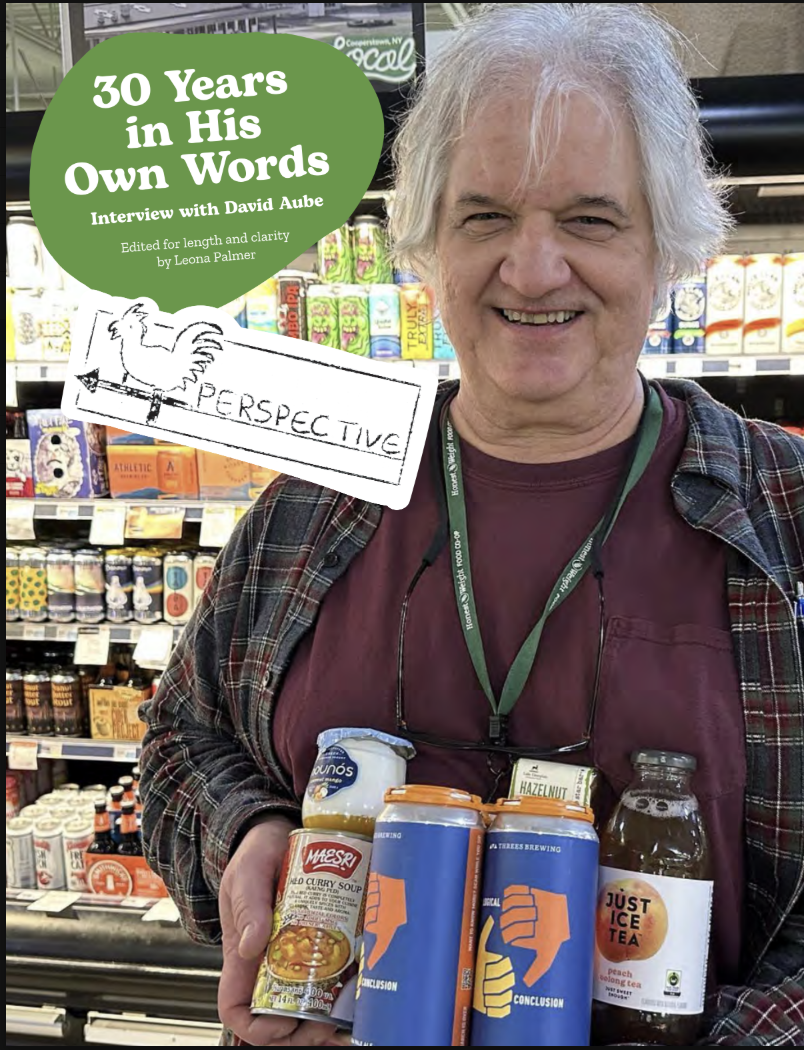
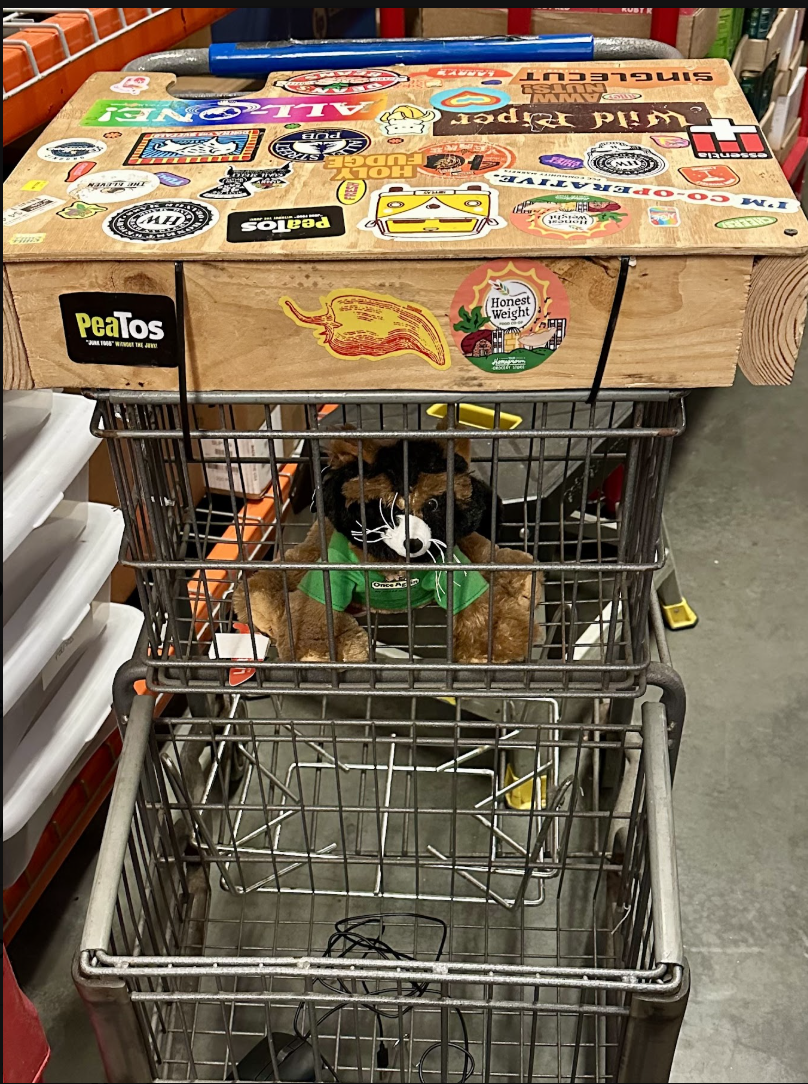
Over the years, in the aisles, you may have wondered at a little modified shopping cart-slash-desk with a cup holder housing a resident toy racoon (more on him later). Or maybe you noticed consistent pages for a manager at the request of a customer who would very much like an explanation as to why we do, or do not, carry a specific brand, product, or item of some kind. Or maybe you maneuvered around this in-depth conversation. David Aube is the friendly face behind all of this. I met David on my first shift as a Member-Owner in the Grocery department during the early days of Covid, and listened as he explained diligently to a frustrated customer why brands were shifting from glass to plastic packaging due to a glass shortage, as well as all the efforts he was making to avoid plastic packaging, during a food crisis, during a global pandemic. Now, after 30 years of consistent dedication and service to the co-op, David retires as Grocery Buyer (but will still be investing time as a Member-Owner!). Here, in his own words, are the biggest changes and consistencies he’s witnessed shape the Co-op in that time.
I joined in 1987 as a member of the Quail Street store. I did some paid labor on clean ups and special projects, some buying —tasks you wouldn't have members do now. In ‘97 I became a full-time employee as an Associate (then called a Floor Manager) and then I became the Assistant Grocery Manager. I took off a little time for childcare and when I came back I was the Assistant Grocery Manager. A month before we moved to the new store, May of 2013, I became the Grocery Manager. After about 6 years, I proposed the job description of a Grocery Buyer: a position exclusively focused on buying, researching new products, meeting with vendors and sales reps to get better pricing, designing the promotional strategy—like end caps—and resetting the store as needed, and advising other buyers. Always as the ultimate backup when it comes to buying in case somebody was sick or a department had a vacancy.
The thing that I really liked doing the most was to work to reduce prices while maintaining our fiduciary responsibilities, which is more complicated than it sounds. I wanted to keep all the options on the shelf: always looking to balance the budget with people's demand for certain products. How much space do we have and how much space does it deserve based on the data? If I reset the store today I would increase space for the beans and crackers—you could double the space allocated and it would still not be enough, there's so many more varieties and brands. It was always challenging to sit down and plan, so busy doing the day-to-day stuff you don't always have time to deal with the big picture stuff.
What has changed over my time here? I think you have two primary factors: increased accessibility of products and corresponding increase of demand. One is the retailer and the other is the consumer and they constantly complement each other in a circular way.
When we opened our doors, people who were into the concept understood us as a bulk buying co-op. But it was hard for a person off the street to walk in and buy stuff; either it was intimidating or it wasn’t obvious how to buy stuff. Now we are a store that tries to make life less complicated. How can we get the customer what they need? To get them from their home to the store and then back home with relative ease, to have the product on the shelf at a reasonable price, to design the way we feature, market, and promote items. The end caps are trying to make it easy: promote products, group them by theme, make sure they are blocked and fronted correctly. In other words, having good operations from end to end.
Moving from one store to another made us much more welcoming to a larger population. We went from a buying club to a storefront and then that storefront was expanded horizontally several times. Then we went to Central Ave, also expanded horizontally. Finally moving to our present address, which to me is like a store for the 21st century. Moving to 100 Watervliet Ave allowed us to increase our varieties of what we already sold but also greatly expand our prepared culinary, deli meats and cheeses, live plants, beer and cider, and mercantile. We've almost maxed out this space already. My metaphor for the stores is like housing. Your first apartment after college, it’s fun and small and a little messy with a lot of roommates so you can afford it, but in a cool, hip neighborhood. Your second apartment, you’ve grown up a little, gotten a better job, maybe you live with a partner—it’s your first “nice” place. And then you buy your first house, you have an even better job, maybe you're married or have a family, and you’re still in the city but now you have a mortgage and health insurance and adult things to consider. So, moving stores has been a big change in accessibility and demand in terms of space and customer-base.
Product-wise, there are several main touch points in the last 27 years which made things more accessible and increased demand. I’m not going to remember these in order. But a major one is when organic cane sugar became an acceptable ingredient. There was a point when we only sold things that were sweetened with non-sugar, like honey, molasses, rice syrup, and sorghum. Agave didn't even exist at the time. There was a lot of debate—should we get stuff with sugar in it? Then literally, almost overnight, the industry changed. If we didn't accept organic cane sugar as an ingredient, we would have almost nothing to sell, we’d just get left behind. You still have to make sure that there are options for people who don't want sugar. But all of a sudden you have a bunch of products that now taste similar to what people are used to in general groceries, like cookies, cereal, and more.
Similarly, when we decided to stock meat. We started as a vegetarian store. HWFC started selling local meat at the central ave store, but it wasn’t until a year in the new store we could offer national meat products such as Organic Chicken broth. I remember the meeting where that happened and then going to the store and stocking broth on a Sunday night. Before that, I remember getting through Thanksgiving and not being allowed to sell chicken broth. Over the years we have revised our meat product guidelines, which are strict. More people are willing to walk through the front door now, especially knowing we are still unique in carrying high-quality products from local farms.
Another key factor for the Co-op and the Co-op movement overall, was the passing of the Organic Foods Production Act of 1990 (actually not implemented until 2002). That is what created official USDA organic labels. Before that there were a lot of different definitions of “organic” across a lot of different associations—some very good and some not so good. This gave a legal definition, and in 2002 they passed the regulations to enforce it. In 1997 they had proposed a bunch of regulations, but they were awful. They included GMO's and sewer sludge residue, and there was significant pushback including co-operatives at large and HWFC in particular. We actually helped force them to come back with a whole new set of regulations. This label made the term organic less mystifying to the general public and allowed the organic industry to become mainstream at large.
The creation of the National Cooperative of Grocers (NCG) in 2001 is another turning point. Before that there were 11 regional cooperative associations. We were in the Northeast Cooperative Association. In 1996, Whole Foods went public and then created a house brand called “365” which increased their financial power and they started buying up other natural markets. This created a challenge to the Co-op movement nationwide. We had to develop a new organizing strategy to increase economic power. The members of NCG are the individual co-ops themselves, so it’s a co-op of co-ops, and we pay dues and vote. This increased our buying power from one co-op to more than 150 nationwide. The COOP Deals you see on the end caps are a national promotional strategy among all co-ops to offer deals 24 times a year across the departments. These sale prices are negotiated by the NCG on our behalf; if I had to do it on my own I would need 5 employees. (We still have deals on local products or produce on a one-to-one basis.) The NCG also provides operational and business expertise but never dictates how any co-op is run, our members determine that.
The maturation of the distribution channels is another key development. There was a time when there was a cooperative distribution channel for each of the 11 regional associations, but then United Natural Foods, Inc (UNFI) started to consolidate all these various distributors and became the largest national distributor of natural foods. NCG has a contract with them. UNFI is our primary distributor with the effect of enhanced accessibility (thus enhancing demand and thus enhancing accessibility). We get six trucks a week from UNFI, all of them large, and they include almost all the grocery, dairy, and freezer departments, and some of what the deli, meat and cheese, and produce departments buy.
Another significant change to the Co-op’s core business was the creation of “house brands”. There are primarily two: “Woodstock” and “Field Day.” “Woodstock” is not technically ‘official’ but is intended to make products very accessible and recognizable to a larger consumer base by mimicking conventional brands, like mayonnaise or ketchup, but made with organic ingredients at a high-value low-price point. “Field Day” is a true house brand, owned by UNFI, designed to be low cost, minimally packaged, and includes high-value pantry staples such as beans, cereal, pasta and sauce, and peanut butter, which are only available in co-ops and independent stores.
It is a fact that corporate ownership has consolidated within the national food industry to such a degree that there are just a handful of companies like Kraft, Heins, Unilever, Nestlé, General Mills, PepsiCo that own a vast amount of natural food brands [By some estimates up to 80% https://www.cornucopia.org/research/who-owns-organic/]. Sometimes companies buy up other companies through hostile means in general stock takeovers. “Late July” was a very hostile takeover by “Campbells.” But the person who started “Late July” took that money and started “Nixie.” Sometimes a takeover increases the availability, like “Honest Tea” being bought by “Coca-Cola,” and was this low sugar brand is available to the general public at corner gas stations, though it’s no longer available now. Sometimes the intent is to destroy a company to eliminate competition, or the brand is diluted or cheapened to a point where it is unrecognizable, or it’s restructured and resold for profit by a hedge company. You also have new companies and brands starting up every day—it is actually incredible the number of new products constantly entering the marketplace with all the hurdles: financing, production, distribution, marketing. Whoever heard of kombucha? Now it's slotted heavily in our store. We don't have enough room for mushroom coffee.
Covid also changed things. No one knew what ‘supply chain’ meant until 2020. In March 2020, decreased labor and purchasing caused major ripples throughout the food chains—from growing and harvesting, to extraction and production and transportation, to stocking and selling—the A-Z of it all. People realized how complicated and fragile it was, not just to pandemics, but also blizzards or earthquakes, labor or management issues, political issues. Companies and organizations did create backup plans and one thing NCG did was sign on with a major secondary distributor, KEHE. I remember buying products for the store in 2020, it was not easy. I was calling lots of different places and we got lots of products from distributors and companies that we never had before. I remember a truckload of beans and paper brands from “Natural Value” in Texas. One thing I would also say about COVID, and I get choked up every time I think about it, it really highlighted how crucial the store staff is, putting themselves in harm's way so customers can get the food they need.
All these touch points, around consolidation of the definition of organic and federal regulation, national distribution, cooperative organization, brand ownership—when you put them all together have definitely increased accessibility of our products to the general public. But, as a buyer and as a Co-op, you have to maintain a balance between national and local. National products increase our returns and financial stability, but local products satisfy our mission, support the regional economy, and make the store interesting and unique. A certain amount of space has to be allocated towards local products that are unique, interesting, trendy, and from regional distribution channels or direct orders from the company. With any new or local item the questions we ask are: do we already have something local and similar, are customers asking for it, is it a local alternative to a national product, or do we need additional offerings due to high sales? A lot of our dairy is regional and direct, since the northeast has a heavy concentration of dairy producers. The co-op has always worked with small or new retailers that other stores might not—maybe they don’t have UPC codes on products or certain farmers paid in cash—we're willing to do that.
Finally, there have been changes on the consumer demand end, mainly a major shift in an awareness of health through food, exercise, and lifestyle. Diet trends come and go, based on increased dietary or medical knowledge, public opinion, and popular influence. Some are manipulated by market forces and some maintain some long-term traction, like gluten-free, paleo, keto, macrobiotic, and vegan. Overall, consumers now have an expanded taste palette, and people are much more willing to experiment with bolder flavors, cuisines, spices, and ingredients. Consumers have an increased desire to be better home cooks. A willingness to spend for gourmet products has also increased over years. We started carrying specialty products such as cheese, beer, coffee, tea, and prepared foods. There was a time when buying a block of really good cheese was not easy. My very first job in this town was at The Cheese Connection on Stuyvesant Plaza that sold good cheese and other gourmet products. Now we buy from local dairies that make endless varieties of good cheese.
Over the years, there’s been a mainstream increased willingness of consumers to buy in accordance with values. Every survey shows that people don't want their money to go towards exploiting labor, or toward unsustainable environmental practices, or practices that are taking from the community. People in our store want to decrease plastic packaging. There is also increased demand for products that are clean, without artificial ingredients, dyes, or preservatives, and non-GMO.
Something that makes retailers such as myself cringe is the rise of the influencer. It is very tricky for retailers to adapt. We’re way past the days of standard visual print advertising. TV shows and now social media promote products all day long and can make an item hot overnight. Black walnut oil became really hot. People came in looking for it and then we sold out. By the time you stock a product—and production ramps up—to meet demand, people have moved on and now you have surplus. Wellness sees this phenomenon frequently in supplements. Of all the things Dr. Oz has promoted, agave syrup stood the test of time. I used to read the ads of different food publications just to see what was trending and try to get ahead of it.
What has stayed the same? Something that has never changed is the Co-op’s staff and membership commitment to maintain ethical buying policy and at the same time a willingness to adjust to consumer demands. This continuity is underneath some of our adaptations: sugar, meat, beer. Our commitment to local products has never changed. Our participatory democratic governance has been constant. Every big question, either local or national, gets analyzed, argued, decided, and then executed at the membership, committee, staff, and board levels. Our commitment has always been to do what we think is the right thing at the time, and most of the time it has been the right thing.
The future of the Co-op? It is very bright. Our biggest issue has always been our success. We’ve gone from a buying club focused on whole, unrefined bulk to a roughly $33.2 million dollar a year organization, serving thousands of customers a week, with a staff of around 180. We have an extraordinarily committed, talented, educated, passionate staff and membership. At some point we reached our maximum number of members and had to apply to the New York State Secretary of State to increase our number past 10,000. We’ve served the city of Albany and surrounding community quite well. We are celebrating our 50th anniversary this year. We have a great building and a great location. Demand for our product is very high. A lot of people who have found their place in the world here, including myself, as a staff or member, dedicated to the mission and the governance.
The Coop movement is at the vanguard of the natural foods industry; we pull the industry. The Co-op’s influence in the overall industry far exceeds our sales. And our sales are really good! We have a lot of leverage. We are one of the largest co-ops, we work with a lot of brands and vendors, various salespeople, brokers, and organizations. There’s a saying, “If you can make it in the co-op, then you can make it anywhere.” I've attended a lot of national events, trade shows, expos, conferences, and we have an excellent reputation on the national level. I'd be walking down an aisle and people would point out, “Oh, you're from Honest Weight” and get into a conversation. A lot of what we are figuring out in the store is problems, our jobs are to figure out problems. Not a lot of people get to experience or realize our larger influence and positive reputation at the national level.
Some good questions for us? How do we reach certain segments of certain demographics and populations to gain new worker and Member-Owners that reflect the general local population? How do we continue to improve operations and capacity? The parking lot is often at maximum capacity. The backroom could use serious reorganization and investment. However, it is hard to find the time to improve when you need to do the day-to-day tasks to satisfy the demand. And then of course you need to have a planning committee, budget, the willingness to have the operations of the store interrupted. To make any changes requires a lot of cooperation and consideration.
A little bit about the raccoon. In 1981, the brand “Once Again” purchased and renovated a turn-of-the-century silk production facility in Nunda, New York and converted it to nut butter production. They found four baby raccoons living in the property and named one “Rocky”. He became the company mascot and logo. I’ve received lots of them as promotional items and given plenty away, my daughter got one at one point. The maintenance guy Brian made the shopping cart desk and coffee holder for me and there was this space, it’s a basket that couldn't fit anything else, so Rocky took up residence and he’s been there ever since.