
Community History: An Interview with Alan McClintock
By Ruth Ann Smalley
If you became a member of Honest Weight some time in the last 40 years, there’s a good chance you’ve met Alan McClintock. He’s ushered new members into the store through orientations since 1981. My family first met Alan when our kids were little, when they were held spellbound by his story-telling magic. I’ve appreciated his kind smile and twinkle-eyed greetings in the store aisles for a couple of decades now. I was eager to hear Alan’s thoughts as we celebrate the 50th anniversary of the Co-op.
Alan is so steeped in the community’s history, my first question was about what aspects of our cooperative’s beginnings he feels we should keep front and center now?
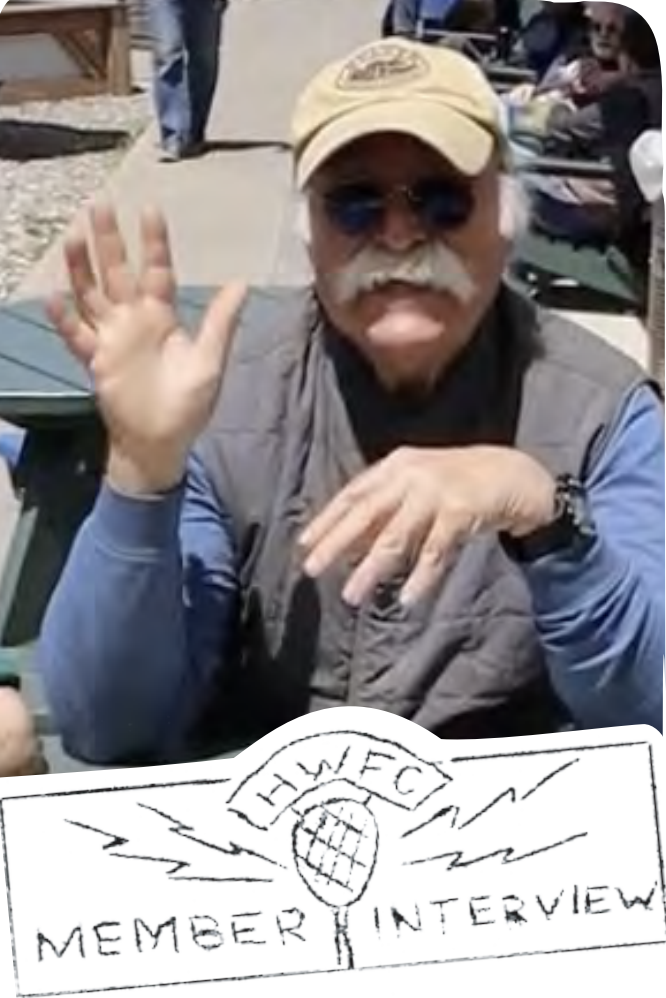
“It’s important to remember to educate and empower our membership to realize the value and importance of cooperative action,” he answered. He cited “our foundational roots, based on the Seven Co-operative Principles.” These are still much-needed values.
And there’s lots of room for leveraging and building on the principles. “There’s more that we could do to build stronger relationships,” he told me. Especially in terms of “supporting other cooperative undertakings in our area,” and “strengthening our relationships with our agricultural community.”
He feels there has been a tension “between the Small is Beautiful model and the need to shift certain practices when scaling up.” Compared with earlier periods, “we are somewhat removed from our farming community.” Examples of collaborative projects he would like to see include things like supporting the development of a local grain mill, and raising more animals locally. Alan sees producers coming to us with their products because of our historic brand, but thinks we should ask, “what are we doing to broaden these relationships?”
I asked Alan to look back over his decades of running orientation sessions for new members. What were some insights he’d gained from those interactions? What observations could he share about people’s views of Honest Weight and their reasons for joining? He describes how common it is for people to remark on the warmth and friendliness of the store. “It’s rare that I’ve heard any negative comments about Honest Weight and our place in our growing community.” People especially remark on how they “love the produce, bulk, and specialty food areas, and store products that show how we have cultivated relationships with local and regional farms and producers.”
He occasionally hears from folks who are drawn to Honest Weight specifically because they’ve been part of a co-op that no longer enables as much member involvement. They describe a sense that their previous store feels as though it has become “a co-op in name only,” or more like what Alan calls “the REI model—more consumption-based.” These folks sometimes travel long distances to shop here. Others are joining a cooperative for the first time because they have recently become “disenchanted with the politics of their previous shopping experience” at massive corporate-owned stores.
“We exist in a very different league than we were in 1977,” Alan told me when I asked about some of the changes he has seen. “The product diversity that exists in the store is directly related to shifts in what to eat and how to eat.” While new members, and especially many younger people, are still interested in the store for its support for local agriculture, many are looking to meet particular food needs, and may also shop in a range of other markets. In his orientation sessions, Alan hears from scratch-cooks, vegans, and people looking for a variety of plant-based products and gluten-free baked goods. Some people are joining after retiring. They’ve shopped here for years, and now have time to get more involved, both for a larger discount and to build more community. “The social aspect appeals to them,” Alan notes. They find it “truly a different environment than other stores.”
Alan expanded on another aspect of demographics and dietary change which I found fascinating, and a bit surprising. “Specific dietary interests are dramatically greater than when we were all vegetarians,” he said. “When I ask people to raise their hands if they are omnivores, it’s the majority. Maybe one or two vegans.” When the co-op started, he said, “probably 100% of ownership were all vegetarians—people who had read Diet for a Small Planet, and were interested in political alternatives” to conventional eating patterns.
In closing, I asked Alan about his thoughts about and visions for the future of Honest Weight Co-op. His strong desire is that “we remain true to the principles that helped to shape us, and that we continue to embrace our mission.” It is important that “our owners remain engaged” as this not only nurtures our present success, but “we are dependent on their energy to support our future.”
View all the Coop Scoop Blog posts here.