
A Member-Owner’s Reflections
by Natalie Criscione
In the summer of 1978, Steve Phelps interviewed Harriet Seeley for the Coop Scoop’s August edition. Phelps was a regular contributor for many years with his Member-Owner interviews that he conducted in person, often over dinner at the interviewee’s home:
“A bit flustered and laughing nervously at the prospect of the Coop’s public, if narrow-beamed spotlight falling upon her,” writes Phelps, “Harriet Seeley compared the surprise request for an interview to another chancy occurrence: ‘I won a watch as a door prize once. This feels like the same kind of thing.’ With a little hesitation, she agreed to accept this prize, too……Emerging from the kitchen, Harriet found me making pad and pencil notes and she froze a little. I explained apologetically that without notes, the writing’s tough and to martial support for my argument, commenced inquiry into the details of her work…Somewhere in this, the quiche came out of the oven and was accompanied by a salad from an untried recipe…’It isn’t worth making a new dish just for myself,’” Harriet said.
Now, 48 years later, as I interview Harriet Seeley about her Honest Weight Food Co-op experiences, I feel as if I’m the winner of a special door prize. I’m grateful for Phelps’s words from long ago and for the opportunity to circle back and share Seeley’s reflections.
Seeley remembers the Quail Street store before it expanded from one, to two, then three rooms and Bob Linn when he was a new manager. Having moved from Boston in 1975, she was drawn to the new co-op for its community feel, fresh foods, and opportunities for involvement. As she moved through the decades, both she and the co-op grew and changed and searched for their niche. As Seeley reflects back, her story is one of discovery and purpose as she filled various roles within the co-op’s Member-Owner structure.
What was it like being a Member-Owner in those early years? “It was loosey-goosey,” says Seeley, “You’d show up to work and were asked, ‘So, what do you want to do today?’” She remembers looking around and asking back, “Well, what is there to do?” One day she was placed on the cash register, an old “push button vintage one,” she recalls. Her cashier career was short-lived however as other, more desirable opportunities presented themselves to her.
When the co-op began ordering from Samascott Orchards in Kinderhook, they needed members to transport cider and apples twice a week as the store did not have enough storage space for more than a single car’s haul. The role was referred to as “cider hauler.” It was a perfect job for Seeley who was covering Columbia County at the time through her job with the Association of the Blind and could easily swing by the orchard. “Once a month, I would stop by after work,” she recalls, “and load up my car with 60 or more gallons of cider and crates of apples.” Over the years, Seeley got to know the multi-generational Samascott family and even helped them bottle the cider if they were running behind. In the summer months, they froze the cider before loading it, and, with no AC in her car, Seeley opened her windows and experienced a refreshingly cool drive back to Albany. Once back at the store, she unloaded her car, filled plastic milk crates with the gallon containers for easy stacking, priced each item, and got everything into the store. “It was my monthly commitment forever—In fact,” she recalls with a laugh, “I may hold the longest cider hauling record in the co-op’s history.” It wasn’t until the Central Ave store expanded and added additional refrigeration space that the orchard itself began delivering; Seeley’s job as a member-owner cider hauler became obsolete.
The Central Avenue store offered other opportunities for her. Another role she filled was that of “shelf-straightener” in which she kept products on the shelves tidy and organized. For a short time, she even recruited her late husband Dan, who loved the co-op and the fresh food offerings, but did not find his passion in shelf-straightening. Because of the store’s layout, and for whatever other reason, there arose a problem of people shoplifting high-end cuts of meat. So, Seeley could sometimes be found during her lunch hour sitting with her knitting in hand and “meat policing,” another now obsolete role. The location also afforded her a good view of the olive bar where she stopped several people from dipping their fingers into the olives for a free sample. Finally, she attended to the job of sorting, cleaning, and flattening reused plastic grocery bags—remember those?
With the opening of the new store, Seeley found herself first providing food demos for customers and then gravitating toward outreach programs. She worked closely with Amy Ellis providing a multitude of outreach education and cooking classes at schools, libraries, community centers, and businesses. More recently, she began involvement with the monthly Serve Albany program, a coalition of leaders from nonprofits throughout the Capital Region. The co-op provides brunch for the attendees, something with which Seeley assists. It is a way of making Honest Weight a presence within the community. “It’s a good gig for me at this point in my life,” she says.
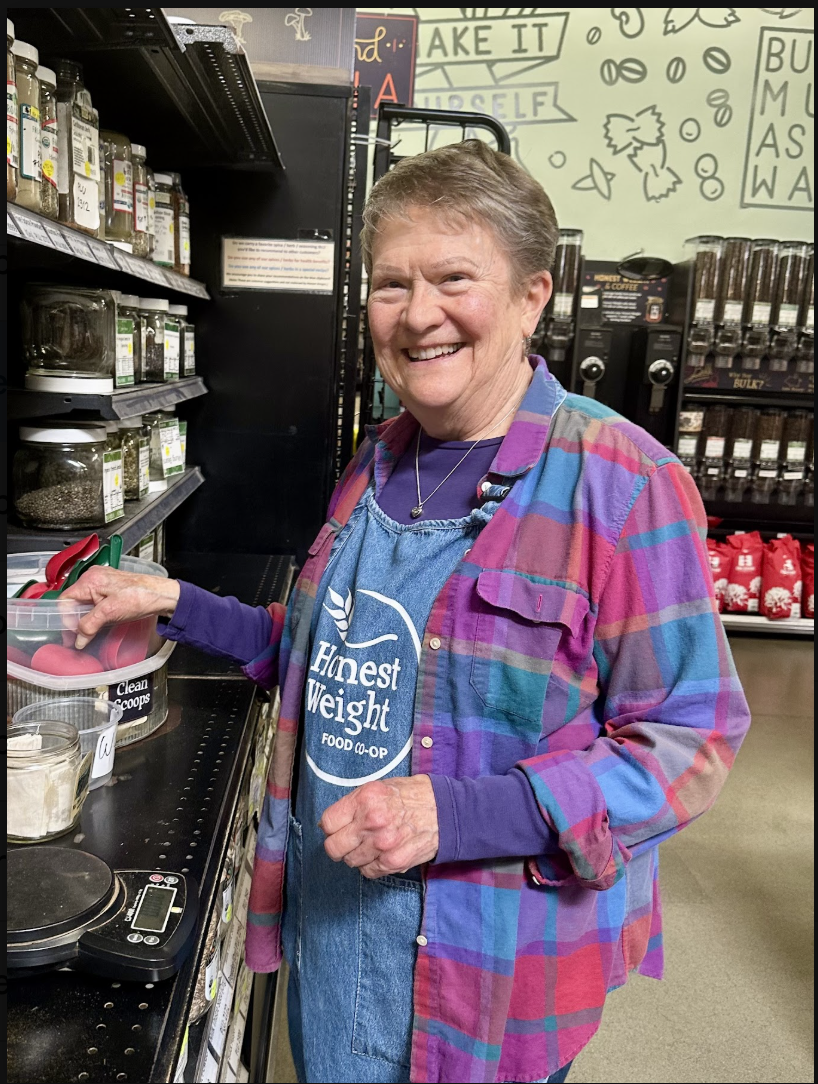
She has also found her niche in the Bulk Department with Phil Enriquez and occasionally Bob Linn. Seeley works mostly in the back packaging raisins, dates, flax seed, and other bagged and packaged items or cleaning bottles that people donate. She loves the people with whom she works, their histories with the co-op, the variety of products, and the diversity of people and cultures that pass through. There is a family-like camaraderie among them and a playful spirit. “Well, here we are with the lead of Our Town,” Linn sometimes exclaims in front of her, referencing a performance he once attended. That cracks her up because in the play Seeley had played a dead body in the cemetery and the audience’s irate one-line woman. “The Bulk Department is really good energy!” she laughs.
As our phone conversation comes to a close and I turn off “record” on my iPad, I think again about Steve Phelps and how he took notes during his interview with a pencil and notepad. I think about how some things change over the course of half a century and how some things don’t change at all. I recall the lyrics from Joni Mitchell’s song “The Circle Game,” an expression of time’s passage and reflections that come with it: “We can’t return, we can only look behind from where we came…” (You, reader, might already be humming the rest of the song.)
View all the Coop Scoop Blog posts here.